↓
 

Urban Astronomer

Making sense of the universe one page at a time

  • News and Updates
  • Astronomy
    • Astronomer Profiles
      • Astronomers Through History
      • South African Astronomers
    • Astronomy 101
      • Questions and Answers
        • Short Questions
      • The Solar System
      • Meteor Showers
    • Bad Science, UFO’s and Modern Myths
  • Making Telescopes
  • Astrophotography
    • Equipment
      • Computer
      • The Optical Train
      • The Mount
      • The Camera
    • Capturing
      • Planning
      • Calibration
  • The Urban Astronomer Podcast
    • Podcast Archive
  • Support the Show

Category Archives: Astronomy 101

One of my main goals is to try and share a bit of knowledge and understanding about the incredible universe. I have been steadily writing and posting various articles to explain and educate the masses (that’s you, dear reader!) a bit more about some of the science behind the hobby. An urban astronomer might never see most of the things we talk about here, but it’s still good to know about them.

Post navigation

← Older posts
Newer posts →

Why don’t scientists believe in UFO’s?

Urban Astronomer avatarPosted on 30 April, 2013 by Allen Versfeld4 June, 2016

A lack of any convincing evidence, mainly.  There have been countless thousands of reports of UFO’s over the last century, but most can be easily explained by natural phenomena or known human activity.  For example, the sighting of a mysterious spinning spiral in the sky above Norway turned out to be a malfunctioning rocket spinning out of control.  Other cases turn out to be the planet Venus (“There’s something hovering above the horizon, as bright as an aeroplane’s landing lights”), … Continue reading →
Posted in Astronomy, Bad Science, UFO's and Modern Myths, Questions and Answers, Short Questions | Leave a reply

Black Hole

Urban Astronomer avatarPosted on 30 April, 2013 by Allen Versfeld

Science fiction movies love a good Black Hole.  It’s dark, mysterious, dangerous and you can wrap all sorts of interesting plots behind it.  Unfortunately, the traditional bad science penned by script writers gets even worse when black holes are added.  Let’s have a look at some of the properties black holes exhibit in fiction: They are unstoppable celestial vacuum cleaners, sucking up anything that strays close by. If you fall into a black hole, you will be teleported somewhere else … Continue reading →

Posted in Astronomy, Astronomy 101 | 1 Reply

What is gravity?

Urban Astronomer avatarPosted on 30 April, 2013 by Allen Versfeld

Gravity is the force that attracts objects with mass towards each other.  On Earth, it is what brings us back to the ground if we jump upwards.  In space, it is what makes the Moon orbit the Earth, what makes the Earth and other planets orbit the Sun, and what makes the Sun and stars orbit the centre of the galaxy.  According to physicists, there are only four forces in the universe, and gravity is the weakest by a ridiculously … Continue reading →

Posted in Astronomy, Questions and Answers, Short Questions | Leave a reply

Nova and Supernova

Urban Astronomer avatarPosted on 30 April, 2013 by Allen Versfeld30 December, 2020
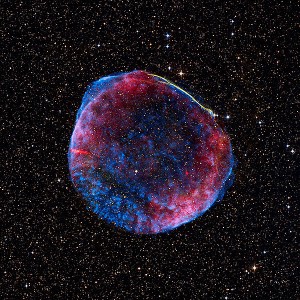
Supernova Remnant SN 1006

For as long as we have looked at the stars, we’ve known that sometimes a new star appears from nowhere.  This has always been a big deal since it was well understood that the stars were eternally fixed in the sky, and could neither move nor change (with the obvious exceptions of 5 bright wandering stars that the Greeks called Planets).  A new star was direct intervention from the gods so it was vital that the astrologers found the corresponding … Continue reading →

Posted in Astronomy, Astronomy 101 | Leave a reply

What is a supernova?

Urban Astronomer avatarPosted on 30 April, 2013 by Allen Versfeld

  A supernova explosion is one of the most powerful releases of energy in the universe.  When the largest stars run out of fuel and collapse, the implosion of their core rebounds with such power that the resulting explosion outshines entire galaxies for several weeks.  All that remains is a tiny dense neutron star, surrounded by an expanding cloud of ultra-hot glowing gas which we see as a beautiful nebula.  If the star was particularly massive, then the remains of … Continue reading →

Posted in Astronomy, Questions and Answers, Short Questions | Leave a reply

Post navigation

← Older posts
Newer posts →
We protect our inboxes with spam protection for domains

Subscribe to Podcast

Apple PodcastsAndroidby EmailRSSMore Subscribe Options
Find our new home on Mastodon Don't click me!
Proudly hosted by Monoceros Digital Consulting -- © Allen Versfeld 2022
↑