↓
 

Urban Astronomer

Making sense of the universe one page at a time

  • News and Updates
  • Astronomy
    • Astronomer Profiles
      • Astronomers Through History
      • South African Astronomers
    • Astronomy 101
      • Questions and Answers
        • Short Questions
      • The Solar System
      • Meteor Showers
    • Bad Science, UFO’s and Modern Myths
  • Making Telescopes
  • Astrophotography
    • Equipment
      • Computer
      • The Optical Train
      • The Mount
      • The Camera
    • Capturing
      • Planning
      • Calibration
  • The Urban Astronomer Podcast
    • Podcast Archive
  • Support the Show

Category Archives: Astronomy

All about astronomy: What it is, how the Solar System works, famous astronomers and more

Post navigation

← Older posts
Newer posts →

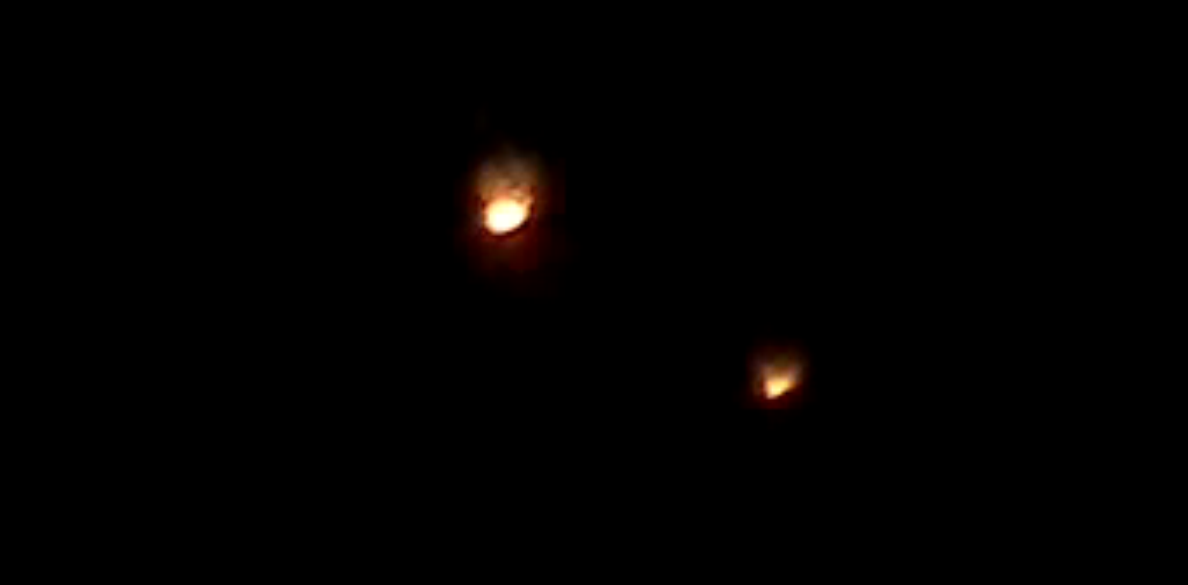
Fireballs over Harrismith

Urban Astronomer avatarPosted on 18 November, 2011 by Allen Versfeld28 June, 2016
Harrismith Fireballs. Image Credit: Riaan van Greuning

Harrismith is a small town in the agricultural heartland of South Africa.  On 30 October 2011, resident Riaan van Greuning saw balls of fire drifting through the sky at high speed, appearing in the sky to the north of his home and heading south before vanishing in the clouds.  Here is an excerpt from his email to Urban Astronomer, providing a lucid and detailed description: They were all moving approximately at the same speed, I would say according to the … Continue reading →

Posted in Astronomy, Bad Science, UFO's and Modern Myths, UFO's | Leave a reply

Will a hammer and a feather fall at the same speed in space?

Urban Astronomer avatarPosted on 1 November, 2011 by Allen Versfeld

  Yes.  Although scientists have been predicting this for centuries, it was finally demonstrated by astronauts in 1971.  David Scott, commander of Apollo 15, took a hammer and a feather out onto the Moon’s surface and dropped them together.  You can watch the attached video to see them landing at the same time.  The only reason feathers fall slowly on Earth is wind resistance.  Feathers are very large for their mass (they have a very low density), so experience a … Continue reading →

Posted in Astronomy, Questions and Answers, Short Questions | Leave a reply

What is an asteroid?

Urban Astronomer avatarPosted on 25 October, 2011 by Allen Versfeld

The official definition of an asteroid is ambiguous, and boilds down to asteroids being rocky, dusty objects orbiting the Sun that aren’t planets.  They come in all sizes with the largest (named Ceres) being over 900 kilometers across and the smallest being mere specks of dust.  Some have been found to have small amounts of ice on them, so that nobody’s quite sure whether to call them asteroids or comets, and others cross over into the definition of Minor Planet. … Continue reading →

Posted in Astronomy, Questions and Answers, Short Questions | Leave a reply

The Five Planets

Urban Astronomer avatarPosted on 12 October, 2011 by Allen Versfeld

  The ancients had beautifully dark skies, dusted with thousands of stars of varying brightness. At some point, they noticed that five of these stars were quite different from the rest.  Not only were they conspicuously bright, but they also moved against the background of the sky, while all the rest were fixed in place.  These movements weren’t all at the same speed, and varied over time, so these special stars became known as “Planets“, from the greek word for … Continue reading →

Posted in Astronomy, Astronomy 101, The Solar System | 1 Reply

How do you measure the brightness of stars?

Urban Astronomer avatarPosted on 12 October, 2011 by Allen Versfeld

A star’s brightness in the sky is referred to as its Magnitude, which is a number with no unit.  In its original ancient form, the magnitude system ranked stars from 1 to 6, with the bigger numbers representing faint stars, so that the faintest star we can see has a magnitude of 6, and a very bright star would have a magnitude of 1.  Since then, a bit of mathematical rigour has been applied to make the system very precise … Continue reading →

Posted in Astronomy, Questions and Answers, Short Questions | Leave a reply

Post navigation

← Older posts
Newer posts →
We protect our inboxes with spam protection for domains

Subscribe to Podcast

Apple PodcastsAndroidby EmailRSSMore Subscribe Options
Find our new home on Mastodon Don't click me!
Proudly hosted by Monoceros Digital Consulting -- © Allen Versfeld 2022
↑