↓
 

Urban Astronomer

Making sense of the universe one page at a time

  • News and Updates
  • Astronomy
    • Astronomer Profiles
      • Astronomers Through History
      • South African Astronomers
    • Astronomy 101
      • Questions and Answers
        • Short Questions
      • The Solar System
      • Meteor Showers
    • Bad Science, UFO’s and Modern Myths
  • Making Telescopes
  • Astrophotography
    • Equipment
      • Computer
      • The Optical Train
      • The Mount
      • The Camera
    • Capturing
      • Planning
      • Calibration
  • The Urban Astronomer Podcast
    • Podcast Archive
  • Support the Show

Category Archives: News and Updates

News about Astronomy and Space Science. Find every news item and update here, in blog format. You can get these updates sent straight to your mailbox by subscribing here, or you can subscribe to the RSS feed by clicking the link.

Post navigation

← Older posts
Newer posts →

The day Earth waved at Saturn

Urban Astronomer avatarPosted on 30 January, 2014 by Allen Versfeld

Last year in July, the Cassini spacecraft was briefly positioned so that it was in the orbit of Saturn, allowing it to point its cameras in the direction of the Sun and capture an ethereally beautiful image of Saturn’s backlit rings. Mission controllers knew that the Earth would be in the field of view of Cassini’s imaging systems, and publicised the event by comparing it to Voyager’s famous Pale Blue Dot image. Campaigners spread the word that as many people … Continue reading →
Posted in News and Updates | Leave a reply

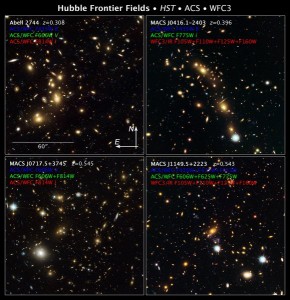
Frontier Fields program unites space telescopes to peer deeper into space than ever before

Urban Astronomer avatarPosted on 28 January, 2014 by Allen Versfeld11 May, 2016
Four of the galaxy clusters that will be studied by Frontier Fields: Abell 2744, Pandoras Cluster, MACS J0416.1-2403, MACS J0717.5+3745, MACS J1149.6+2223 NASA, ESA, and Z. Levay (STScI/AURA)

In an ambitious effort to look further out into the universe than anybody has ever seen before, NASA will be combining the efforts of its three flagship space telescopes (The Hubble Space Telescope, the Chandra X-ray observatory and the infrared Spitzer Space Telescope) in a new program called Frontier Fields. Together they will use the gravitational fields of distant galaxy clusters to magnify the light from distant objects that would normally be a hundred times too faint to be seen … Continue reading →

Posted in News and Updates | Leave a reply

Carnival of Space #338

Urban Astronomer avatarPosted on 26 January, 2014 by Allen Versfeld11 May, 2016
Carnival of Space Image Credit: Jason Major

Welcome to the 338th Carnival of Space! Every week space science and astronomy bloggers from around the world submit their best work to the Carnival of Space curator, whose job it is to collect their articles into one easy-to-parse summary of what’s new and relevant in the field. This week’s carnival curator is me, and you will find the submissions below:First up is Nancy Atkinson from Universe Today, with exciting news from the Herschell orbital observatory about the discovery of … Continue reading →

Posted in News and Updates | Tagged Carnival of Space | Leave a reply

Ultra-compact galaxy M60-UCD1 discovered

Urban Astronomer avatarPosted on 24 January, 2014 by Allen Versfeld

Astronomers working with the Hubble Space Telescope and the Chandra Xray Observatory have discovered a nearby galaxy which crams an incredible number of stars into a very small space.  The galaxy, named M60-UCD1, is classed as an Ultra-Compact Dwarf Galaxy and spans only 160 light years across.  The Milky Way, by contrast, is almost a thousand times larger than this.M60-UCD1 was discovered by the Hubble Space Telescope, and lies along a line of site very close to the more famous … Continue reading →

Posted in News and Updates | Leave a reply

No methane on Mars

Urban Astronomer avatarPosted on 19 January, 2014 by Allen Versfeld

Planetary scientists can tell a lot about a planet by studying the light reflected off its surface, and filtered through its atmosphere.  One of the things that these techniques had taught them about Mars was that the planet contains a lot of methane in its atmosphere.  This was very exciting, since once of the best sources of methane is the exretions of living organisms.  But a few months ago, the Mars Science Laboratory (MSL), more commonly known as the Curiosity … Continue reading →

Posted in News and Updates | Leave a reply

Post navigation

← Older posts
Newer posts →
We protect our inboxes with spam protection for domains

Subscribe to Podcast

Apple PodcastsAndroidby EmailRSSMore Subscribe Options
Find our new home on Mastodon Don't click me!
Proudly hosted by Monoceros Digital Consulting -- © Allen Versfeld 2022
↑