↓
 

Urban Astronomer

Making sense of the universe one page at a time

  • News and Updates
  • Astronomy
    • Astronomer Profiles
      • Astronomers Through History
      • South African Astronomers
    • Astronomy 101
      • Questions and Answers
        • Short Questions
      • The Solar System
      • Meteor Showers
    • Bad Science, UFO’s and Modern Myths
  • Making Telescopes
  • Astrophotography
    • Equipment
      • Computer
      • The Optical Train
      • The Mount
      • The Camera
    • Capturing
      • Planning
      • Calibration
  • The Urban Astronomer Podcast
    • Podcast Archive
  • Support the Show

Category Archives: News and Updates

News about Astronomy and Space Science. Find every news item and update here, in blog format. You can get these updates sent straight to your mailbox by subscribing here, or you can subscribe to the RSS feed by clicking the link.

Post navigation

← Older posts
Newer posts →

Black Hole at core of Milky Way flares

Urban Astronomer avatarPosted on 11 December, 2012 by Allen Versfeld

The black hole at the core of the Milky Way flares up in a series of images captured by NuSTAR.   Image credit: NASA/JPL-Caltech   On 13 July, NASA launched the Nuclear Spectroscopic Telescope Array (NuSTAR), an orbital X-ray telescope that can produce detailed images in high-energy.  Now, NuSTAR has directly observed the supermassive black hole at the centre of the Milky Way galaxy (known as Sagittarius A*, or just Sgr A*) flaring up as material falls in. Unlike some other … Continue reading →
Posted in News and Updates | Leave a reply

ASSA Symposium 2012 report – day one

Urban Astronomer avatarPosted on 28 November, 2012 by Allen Versfeld

On 12 October 2012, the Astronomical Society of South Africa (ASSA) began their 9th biennial symposium, hosted by the Cape Centre of ASSA at the offices of the South African Astronomical Observatory (SAAO).  Although it officially began on Saturday the 13th, there were a few extra activities lined up for the Friday as well, for those ASSA members who arrived early.  These were an astrophotography workshop hosted by Dale Liebenberg, a free show at the Iziko Planetarium, and a social … Continue reading →

Posted in News and Updates | Leave a reply

Curiosity identifies old river bed on Mars

Urban Astronomer avatarPosted on 27 November, 2012 by Allen Versfeld

As we put more robots on or around Mars, we get more data suggesting that Mars was once a wet world.  The most convincing data yet comes from the Curiosity rover (an SUV sized plutonium powered robotic explorer, formally known as the Mars Science Laboratory) which has just driven through what is almost certainly an ancient dry river bed.  The evidence is purely geological:  smooth pebbles, cemented into a layer of conglomerate rock, prove convincingly that water used to flow … Continue reading →

Posted in News and Updates | Leave a reply

Ozone Hole at 2nd smallest in 20 years

Urban Astronomer avatarPosted on 26 November, 2012 by Allen Versfeld4 June, 2016
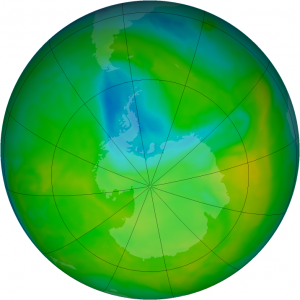
Ozone Hole - 23 November 2012

Good news for those of us who’re so proud of our sunny weather in the southern hemisphere:  Earth-watching satellites belonging to NASA and the National Oceanic and Atmospheric Administration (NOAA) have shown that the ozone hole is beginning to heal.  So far this year, it’s covered an average area of 17.9 million square kilometers, with a peak reading on 22 September 2012 of 21.2 million square kilometers – a substantial reduction from the maximum size recorded in 2000 of 29.9 … Continue reading →

Posted in News and Updates | Leave a reply

A world with two Suns

Urban Astronomer avatarPosted on 7 November, 2012 by Allen Versfeld23 December, 2020
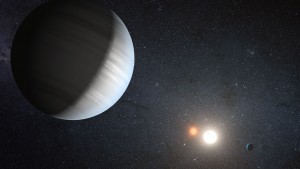
Artist's impression of the Kepler-47 system.

A few months ago, the Kepler space telescope discovered something new:  A pair of planets, orbiting a pair of stars.  Somebody standing on these worlds would see two suns in the sky, and could enjoy the science-fiction view of a double sunrise, and double sunset.  The system, known as Kepler-47, is located in the constellation Cygnus (the Swan), and is about 5000 light years away from Earth.  Astronomers using data from the Kepler telescope detected the planets using the transit … Continue reading →

Posted in News and Updates | Leave a reply

Post navigation

← Older posts
Newer posts →
We protect our inboxes with spam protection for domains

Subscribe to Podcast

Apple PodcastsAndroidby EmailRSSMore Subscribe Options
Find our new home on Mastodon Don't click me!
Proudly hosted by Monoceros Digital Consulting -- © Allen Versfeld 2022
↑